


5th December 2025
Meta Description Best Practices: How to Turn Rankings into Clicks
Meta descriptions sit at the point where search demand turns into real traffic. They do not affect rankings directly, but they strongly influence whether users choose your result or a competitor’s.
Most sites either ignore meta descriptions or treat them as a one-off SEO task. This is a mistake, as a well-written description can lift click-through rate (CTR) without increasing spend, creating more value from the rankings you already have.
This guide focuses on what actually matters. You will learn what meta descriptions do, why they influence performance, where most sites go wrong, and when fixing them is worth the effort. If you want to turn visibility into visits and visits into revenue, meta descriptions are one of the simplest places to start.
What is a meta description?
A meta description is a short summary of a webpage that appears in search engine results pages (SERPs). It sits below the page title tag and URL.
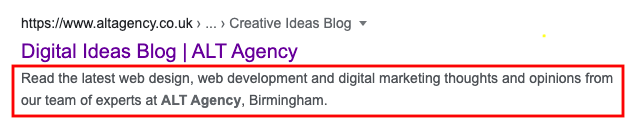
Meta descriptions help searchers understand what a page offers before they visit it. When written well, they set clear expectations and attract users who are more likely to engage or convert. When they are missing, vague or misleading, searchers hesitate or choose a competitor.
If you care about turning rankings into traffic, meta descriptions are a core part of how your site competes on the SERP.
Why are meta descriptions important?
Meta descriptions directly affect CTR. CTR is the percentage of users who click your result after seeing it.
On a crowded SERP, users scan quickly. The meta description is the largest block of copy you control, often taking up around half of the visible space. That makes it your primary lever for influencing behaviour.
Effective meta descriptions:
- Increase qualified clicks without improving rankings
- Reduce wasted traffic by setting accurate expectations
- Support conversions by attracting users with real intent
This matters commercially. Improving CTR increases organic traffic without additional media spend. It also improves the quality of that traffic, which in turn lifts engagement and conversion rates.
What most websites get wrong with meta descriptions
Most meta description problems are not caused by missing tags or technical errors. They come from how descriptions are written and how much priority they are given.
A common mistake is writing meta descriptions for search engines instead of users. This usually shows up as keyword-heavy copy that technically matches a query but gives the user no reason to click. When the copy feels forced or generic, users scroll past it.
Another issue is mismatch. Many descriptions promise content, offers or outcomes that the page does not actually deliver. This leads to poor engagement and higher bounce rates, and it increases the likelihood that Google rewrites the description using on-page content. Once that happens, you lose control over how the page appears in search.
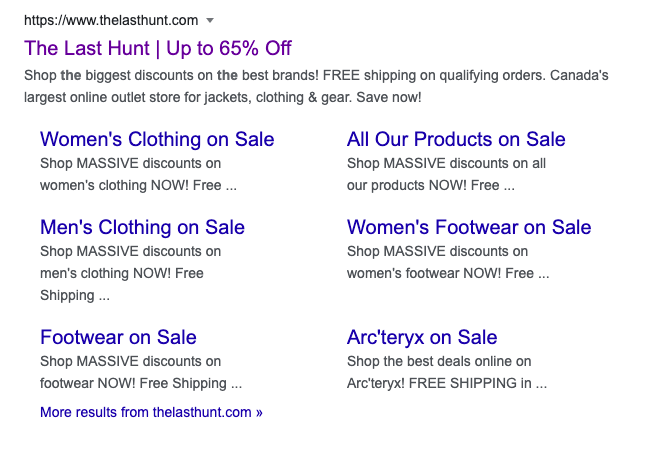
Duplicate meta descriptions are another widespread problem, particularly on ecommerce and large sites. Pages with similar layouts often reuse the same description across multiple URLs. From a user perspective, this removes any reason to choose one result over another.
The meta description below, where the same discount-led messaging is repeated across multiple pages, is an example of this:
Length is often misunderstood. Some sites obsess over character limits, while others ignore them completely. Overlong descriptions get truncated and lose their key selling points. Very short descriptions are more likely to be rewritten by Google. Length matters, but it is a constraint, not a strategy.
Finally, many sites treat all pages the same. Time gets spent refining descriptions on low impact pages, while commercially important category, product or service pages are left vague or auto-generated.
How to write effective meta descriptions for SEO
Writing effective meta descriptions is less about following a checklist and more about making the right decisions in the right order.
1. Be clear about the page’s role
Start by defining what the page is meant to do. Is it designed to inform, compare or convert? The meta description should support that purpose directly. Blog content should signal usefulness. Category and service pages should signal value and intent.
Below is an example of a great meta description for a conversion-focused page. The description leads with the product, reinforces quality with “award winning” and supports immediate action. It aligns tightly with a transactional page whose role is to convert:

If the description does not reflect the page’s job, it will attract the wrong traffic or fail to convert.
2. Lead with the main benefit
Open with the strongest reason to click. This could be a saving, a differentiator, a convenience or a proof point. Avoid generic summaries that simply restate the topic of the page. The following is a great example of this:

High performing descriptions answer the user’s unspoken question straight away: what do I get if I click this?
3. Reinforce relevance with keywords
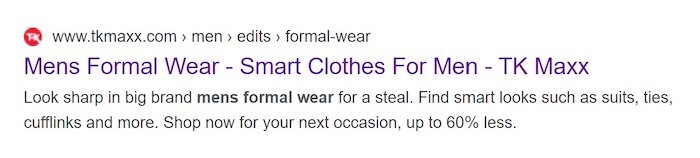
Include the primary keyword naturally within the description. This helps Google highlight matching terms in the search results, which reassures users that the page is relevant to their query.
The keyword should support the message, not overwhelm it. The primary keyword should be included naturally within the copy, as in the example below:
If the sentence reads poorly, the keyword placement is wrong.
4. Make the outcome obvious
Effective meta descriptions set expectations clearly. Users should know what they will see when they land on the page and what action they can take next. This improves engagement and reduces wasted clicks.
Simple calls to action work well when they match intent, for example “learn more”, “browse the range” or “get started”.
5. Keep the message concise
Most descriptions truncate beyond roughly 155 to 160 characters. That makes the opening line critical.
Put the most important information first. If the description truncates slightly at the end but the value is already clear, it will still perform.
When meta descriptions are worth fixing (and when they’re not)
Fixing your meta descriptions only makes sense when there is something to gain. They are worth prioritising on pages that already receive impressions in search but underperform in terms of CTR.
High value pages should always come first. Category pages, product pages and service pages that contribute directly to revenue benefit most from clearer, more compelling descriptions. Small improvements in CTR on these URLs compound quickly.
Meta descriptions are also worth fixing when:
- Google is frequently rewriting them
- Duplicate descriptions appear across important pages
- The current copy does not reflect the page’s value or intent
In these cases, you are losing control of how your site appears at the point of decision. However, there are times when meta descriptions are not worth the effort.
Pages with no meaningful impressions will not benefit from rewritten descriptions. The issue there is visibility, not messaging. Likewise, low value pages that do not support conversions or lead generation rarely justify manual optimisation.
The long-and-short of it is simple; optimise meta descriptions where they can turn existing demand into better outcomes, ignore them where they will not move the needle.
If you want meta descriptions handled as part of a wider SEO campaign, that’s where our SEO specialists can help.

Klaudia Majewska
Klaudia Majewska is an SEO Account Manager responsible for planning, executing and reporting on SEO campaigns across a range of clients. Her work focuses on turning strategy into consistent, measurable performance through clear priorities and ongoing optimisation. Klaudia has a strong technical SEO background and works closely with emerging AI-led search formats. She specialises in making sure products and services are structured and presented in ways that perform across both traditional search results and newer AI-driven search experiences.
Could your meta descriptions bring in more clicks?
Better search snippets for the pages that already have visibility.
Meta descriptions do not directly improve rankings, but they can help turn search impressions into useful traffic. When they are clear, relevant and written around user intent, they give people a better reason to choose your result. Our SEO team improves meta descriptions, title tags and on-page SEO for commercially important pages, helping you get more value from the rankings your website already has.
Improve Your Search Snippets