



13th January 2026
How to Find Out What Keywords Your Competitors Are Using
Guessing which keywords will drive results wastes time, budget and effort. In SEO , chasing keywords because they “sound right” rarely leads to meaningful growth for any business.
Competitor keyword research removes that uncertainty. It shows which terms already generate traffic in your market. More importantly, it reveals how real users search, what they expect to find and where commercial intent actually sits.
This is where the importance of keyword research becomes clear. In practice, its value is not volume, but relevance. The right keywords attract potential customers who are actively looking to buy, enquire or compare options. That is what drives leads, sales and a faster return on investment.
Understanding which keywords your competitors rely on allows you to focus on opportunities that already deliver results, rather than investing in content that never moves the needle.
Which competitor keywords matter most
Not every keyword your competitors rank for is worth targeting. Many terms look attractive in tools but deliver little or no commercial value.
The priority is identifying keywords that align with how your business actually makes money. In most cases, that means focusing on the following areas.
Keywords that drive traffic and conversions: These are the terms people use when they are ready to buy, enquire or take the next step. They are often lower in volume, but higher in intent and conversion rate.
Gaps in your own coverage: These are keywords your competitors rank for that you do not. When those terms already generate traffic and conversions for others, they represent opportunities rather than speculative bets.
Organic versus paid keywords: Organic rankings show where competitors earn ongoing traffic without paid media spend. Paid keywords highlight terms they are actively investing in, which often signals proven profitability. Each serves a different purpose, but both help inform prioritisation.
The goal is simple: identify the terms that matter, understand their value and prioritise the ones that will grow traffic, leads and revenue.
When competitor keyword research is not the right starting point
Competitor keyword research is powerful, but it is not always the best place to start.
In some situations, competitor data provides limited insight or can even mislead prioritisation. This is most common when you operate in a new or highly differentiated market, where competitors are not targeting the same problems or audiences.
It is also less effective when brand demand drives most performance. If users already search for you by name, competitor keywords may have little influence on growth, even if you manage to rank highly for them.
The key is judgment. Use competitor data where it reflects real market behaviour. Avoid forcing it where it does not.
How to research competitor keywords
Once you know which competitor keywords are worth pursuing, the next step is execution. This process turns insight into action and ensures effort is focused where it will actually deliver returns.
We use Ahrefs to do this. It is an SEO tool that shows which keywords competitors rank for, how much traffic those keywords generate and how competitive they are. Used correctly, it allows you to identify genuine opportunities rather than relying on assumptions.
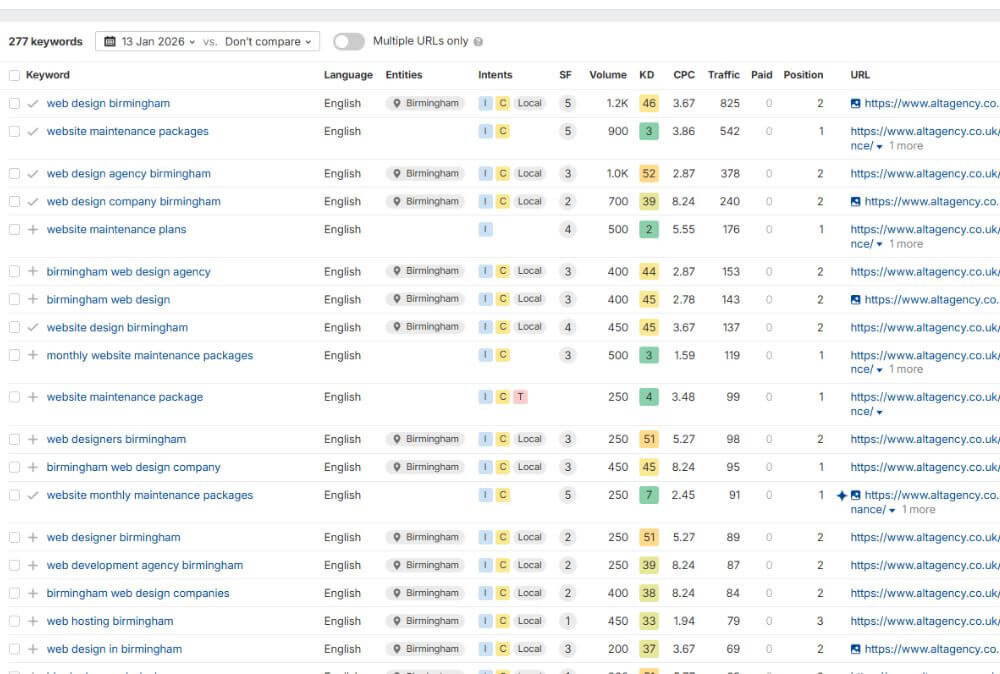
The steps below show how to identify your real competitors, understand where their traffic comes from and uncover gaps in your own keyword coverage.
1. Identify your competitors
Your competitors are not just the brands you recognise. They are the sites ranking for the keywords that matter to your business.
Begin with your existing keyword list in Ahrefs. This should include the terms you already target and the ones you want to prioritise.
Next, search those keywords in Google and review the first page of results. These sites are your true competitors. They are the businesses currently capturing visibility, traffic and conversions for the searches you care about.
Not every site on page one should be treated the same. Directories and publishers, for example, often rank for commercial keywords, but they compete in different ways. Assess these separately rather than treating them as direct competitors for content and optimisation purposes.
It is also important to consider search intent. Some results target research and comparison, while others are designed to convert. Focus on competitors whose pages serve the same intent as your own, otherwise keyword comparisons become misleading.
By the end of this step, you should have a clear list of competitor domains and the keywords they rank for. This provides a reliable foundation for the analysis that follows.
2. Consider SERP features and hidden competition
Most search results now include SERP features such as featured snippets , product listings, local packs and People Also Ask boxes. More recently, Google has introduced AI Overviews, which can appear above traditional results and further limit organic visibility.
It is important to account for this before prioritising keywords. A page ranking in position three may still receive limited traffic if the results page is dominated by other features.
Understanding the full results page helps set realistic expectations and prevents targeting keywords where visibility is structurally limited.
3. Find their organic keywords in Ahrefs
Once you have a clear list of competitors, the next step is to understand where their organic traffic actually comes from.
You can use Ahrefs Site Explorer to analyse each competitor domain:
- Enter the competitor’s domain into Ahrefs Site Explorer.
- Open the Organic Keywords report. This shows:
- Keywords they rank for: The search terms currently sending traffic to their site.
- Search volume: The estimated monthly demand for each keyword.
- Keyword difficulty (KD): Ahrefs’ estimate of how competitive it is to rank on page one. Keyword difficulty should be used as a directional guide, not a decision-maker. Take a look Ahrefs’ Keyword Difficulty (KD) documentation to understand how the metric is calculated and what it actually represents.
- Estimated traffic: How much organic traffic each keyword is likely to contribute.
Keyword data provides the foundation, but it should not be taken at face value. To assess competition properly, you need to review the actual search results. Look at the authority of the domains ranking on page one, the number and quality of backlinks pointing to those pages, the depth and relevance of the content, and how well each result matches search intent. A keyword may appear difficult in a tool, but still present an opportunity if weaker or poorly aligned pages are ranking.
While keyword data provides the foundation, it is also useful to understand how competitors perform more broadly. Looking at overall organic traffic, top performing pages and backlink profiles can help explain why certain keywords drive results for them. This adds context to your analysis and makes it easier to prioritise opportunities that are both relevant and realistically achievable.
At this stage, resist the temptation to sort by volume alone. High search volumes do not guarantee commercial value or realistic opportunity.
Instead, highlight keywords that meet two conditions. They should have enough demand to matter and a level of competition that aligns with your current authority and resources.
By the end of this step, you should have a focused shortlist of high value keywords to take forward, rather than an unfiltered export that just creates more noise.
4. Identify keyword gaps and opportunities
Competitor keyword data only becomes valuable once it is filtered and prioritised. Not every gap is worth filling, and not every ranking opportunity will justify the effort.
The aim of this step is to identify high value keywords your competitors already monetise but you currently miss. By the end, you should have a clear, prioritised view of where focused work can realistically deliver impact.
Start by comparing competitor keyword data with your own.
Tools such as Ahrefs can support this process. The Content Gap tool highlights keywords your competitors rank for that you do not, while the Competing Domains report shows which sites overlap most with your keyword coverage. Reviewing these alongside overall organic traffic and top-performing pages helps you understand where competitors outperform you and where you already compete effectively. Then, you should turn your attention to the following steps:
- Export your competitors’ organic keywords from Ahrefs.
- Combine this with your own keyword set (i.e. the keywords your website currently ranks for)
- Identify keywords where competitors rank consistently and you have no visibility or sit well beyond page one.
From there, prioritisation matters more than completeness:
Focus on commercially relevant gaps: Prioritise keywords closely aligned to your products or services. Search volume only matters if the term supports real demand from potential customers.
Look for realistic opportunities: Keywords with moderate competition and proven traffic often deliver better returns than highly competitive head terms. These are usually faster to rank for.
Group keywords into clusters: Related terms should be treated as a single opportunity, not separate tasks. Clustering allows one page to capture broader demand, improves topical relevance and avoids unnecessary duplication.
Separate by search intent: Transactional keywords signal users ready to act, while informational keywords support research. Both have value, but they serve different roles and should not be prioritised in the same way.
Document decisions, not just data: Create a working list of prioritised opportunities grouped by intent and cluster. Assign ownership and timelines where needed to keep execution moving.
By completing this step, you move away from guesswork and towards a structured roadmap. The result is a set of keyword opportunities chosen for their ability to grow traffic, leads and revenue, not because they simply appear in a tool.
5. Common mistakes to avoid
Even with the right data, competitor keyword research often fails at the execution stage. The most common issues are avoidable.
One frequent mistake is exporting too much data and treating all opportunities equally. Large keyword lists slow decision-making and dilute focus.
Another is chasing competitors with significantly higher authority. Keywords may look achievable in tools but remain unrealistic in practice.
Intent mismatch is also common. Targeting informational queries with sales pages or transactional terms with thin content, rarely delivers results.
Avoiding these mistakes keeps effort focused on work that can actually deliver impact.
6. Take action
Keyword research only creates value when it informs execution. Insight without action does not improve rankings, traffic or revenue.
The purpose of this step is to turn prioritised keyword opportunities into focused changes that can be implemented, measured and refined. The key things to focus on are:
Create or improve pages deliberately: Use keyword research to guide decisions, not inflate page counts. Create new pages where genuine gaps exist, and optimise existing content where it can be expanded, restructured or better aligned to search demand. Each page should have a clear purpose and defined keyword focus.
Align content to user intent: Every page must solve the customer’s problem more clearly than competing results. That means answering the right questions, addressing objections and making the next step obvious. Pages that match intent convert, while those that miss it dilute effort.
Measure outcomes, not just rankings: Track which keywords contribute to leads, enquiries or revenue, not just visibility. Use this data to refine page structure, improve internal linking and adjust content clusters. Where performance stalls, reassess intent and competitiveness before investing further time.
7. Track competitor keyword performance over time
Competitor keyword research is not a one-off task. Rankings shift, new content is published and search demand changes. Without ongoing tracking, it is difficult to know whether your strategy is working or where new opportunities are emerging.
Use tools such as Ahrefs to monitor how competitors’ rankings change over time. Track which keywords they gain visibility for, where they lose positions and how their overall traffic trends develop. This helps you identify patterns, such as competitors strengthening coverage in specific areas or losing ground on key commercial terms.
Review this regularly, either monthly or quarterly depending on how active your market is. A lighter monthly check helps you monitor movement and spot emerging trends, while a deeper quarterly review allows you to reassess competitors, identify new keyword gaps and refine your priorities. The aim is not to react to every change, but to maintain a clear view of direction and adjust where it will have the most impact.
Competitor keyword research shows where demand already exists. Focus on the terms that matter, build pages that serve real intent and measure success by the real results from this.

Klaudia Majewska
Klaudia Majewska is an SEO Account Manager responsible for planning, executing and reporting on SEO campaigns across a range of clients. Her work focuses on turning strategy into consistent, measurable performance through clear priorities and ongoing optimisation. Klaudia has a strong technical SEO background and works closely with emerging AI-led search formats. She specialises in making sure products and services are structured and presented in ways that perform across both traditional search results and newer AI-driven search experiences.
Are your competitors getting found before you?
SEO that focuses on the keywords that actually matter.
Our SEO team develops SEO strategies around real search demand, helping you target the keywords most likely to drive traffic, enquiries and sales rather than wasting time on terms that look good in a report but do not deliver.
Improve Your SEO Strategy